
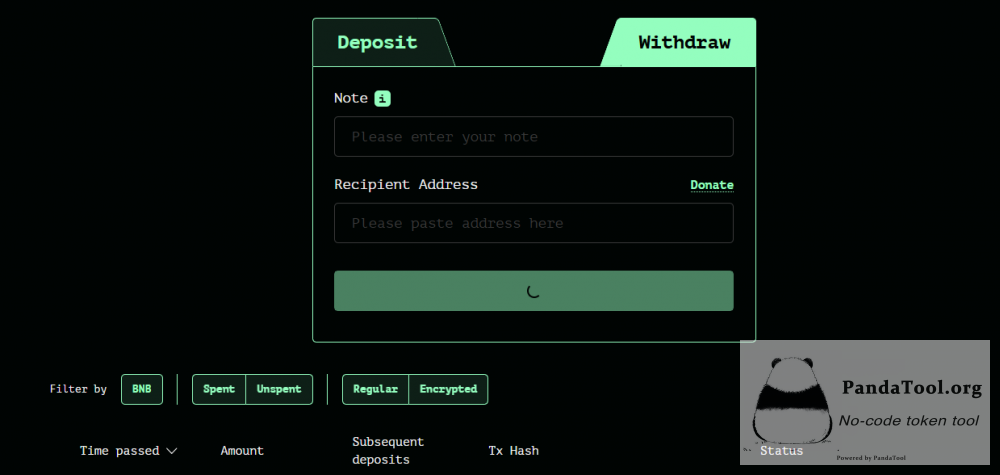
Many users believe that using our mixer at PandaTool (tornado.pandatool.org) makes their funds instantly “invisible.” However, on-chain data suggests that nearly 50% of users dox themselves within 10 minutes of withdrawal.

We’ve observed a recurring—and risky—pattern:
-
User mixes funds on the BNB Chain.
-
Immediately opens TokenPocket (TP) or OKX Wallet.
-
Uses the built-in “Swap” or “Bridge” feature.
-
Moves assets to TRON (as USDT) via HiFi Bridge or ButterSwap.
The logic is: “I’ve already mixed my coins; surely adding a cross-chain swap makes me untraceable?” Unfortunately, that’s like wearing a gas mask to a secret meeting, only to hand out your business card at the door. Today, PandaAcademy will break down how to execute a true “Silent Exit.”

Trap #1: Immediate Swaps/Bridging — It’s “Moving,” Not “Shuffling”
Common tools like TP Swap and OKX Web3 Bridge are convenient but act as “megaphones” for your data.
-
The Secret of TP Swap: It utilizes bridges like Hifi or ButterSwap. These records are 100% transparent. If you withdraw 10 BNB from a mixer and immediately swap it for TRON-based USDT, a simple Hash search reveals the link between the two addresses instantly.
-
OKX Bridge: Similarly, OKX aggregates mainstream bridges that use “point-to-point” paths. To on-chain analytics tools, these are as clear as footprints in fresh snow.
-
Summary: This isn’t “shuffling” your trail; it’s just moving house while the moving company broadcasts your new address on a billboard.
【Pro-Tips】
-
Patience is a Virtue: Wait at least 24 hours (or more) before withdrawing to break the time correlation.
-
The “Cooling Off” Period: Let the funds sit in a “clean address” for a few days before moving them.
-
Use Privacy-First Bridges: If you must go cross-chain, use tools like SilentSwap or Railgun, which obscure the sender-receiver relationship.
Trap #2: Identical Amounts & Straight-Line Logic
Since the PandaTool protocol (based on TornadoCash) requires a full one-time withdrawal for security, you cannot split the withdrawal amount. Therefore, you must manipulate Time and Distribution.
【Pro-Tips】
-
Strategic Deposits: If you have 1000 BNB to mix, don’t deposit one giant lump sum. Break it into multiple deposits of varying amounts at different times.
-
Fragment Your Exit: After withdrawal, split the funds into multiple addresses and process them over several days. The golden rule of privacy: “Stay Slow, Stay Messy.”
Trap #3: Address Contamination & Device Fingerprinting
Mixing funds in Wallet A and then sending them to your “daily” Wallet A defeats the purpose. Furthermore, on-chain anonymity does not equal device anonymity. Your IP address and browser trackers can link your activities.
【Pro-Tips】
-
Dedicated Wallets: Always use a “clean,” dedicated wallet for mixed funds. Never let it interact with your KYC-linked addresses.
-
Privacy Browsers: Stop using Chrome for sensitive transactions. Use Brave or Tor Browser to block tracking and fingerprinting.
-
Avoid CEX “Dead Ends”: Depositing mixed funds directly into a CEX (Binance, OKX, etc.) links your on-chain history to your real-world identity.
Final Word from PandaTool: A tool is just a shovel; how you dig is up to you. The secret to staying low-key in Web3 is simply to be slower and more random.
本文由PandaAcademy原创,如若转载,请注明出处:https://academy.pandatool.org/en_US/kn/2504
。PandaAcademy是PandaTool旗下的Web3学习中心,专注于向普通用户提供区块链和加密货币知识输出