

When creating a Raydium CLMM pool for a token with PandaTool, I noticed two options for supplying liquidity: single-token deposit and dual-token deposit. What distinguishes them?

Yes — there are differences. This is a new feature from PandaTool; here’s a concise explanation.
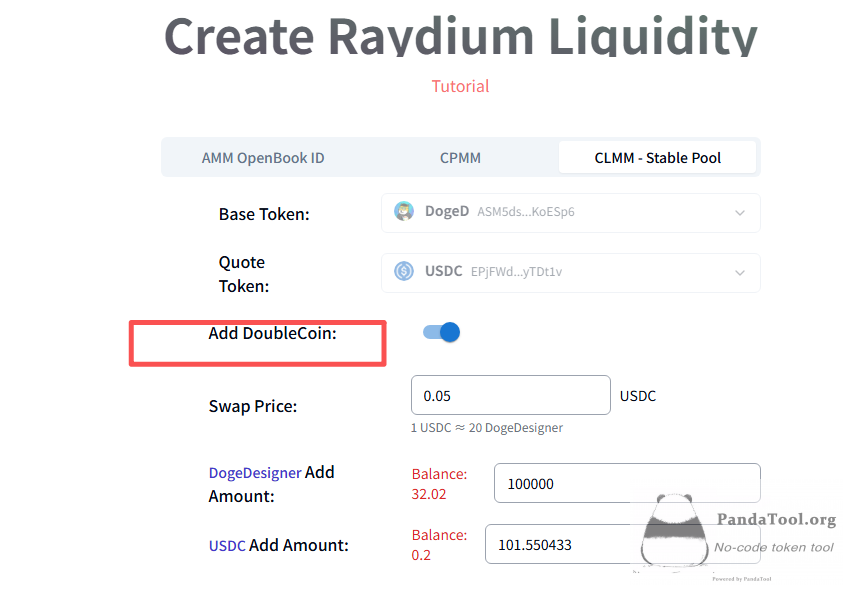

Core point: whether you use single- or dual-token deposits does not change the “stable” nature of the pool — both approaches are designed to keep the price stable. The difference lies only in how liquidity is added.
• Single-token deposit: you supply only the issued token (you do not need to add a quote token such as USDT or SOL). The pool accepts that single-token contribution.
• Dual-token deposit: you supply both tokens at a fixed ratio (PandaTool’s example uses a 1:1000 ratio). After adding liquidity the pool remains stable.
Important clarification: if you add liquidity at a 1:1000 ratio, that does not mean the market price will automatically become 0.001. The actual price is determined by the price you set when creating the pool; the deposit ratio for dual-token liquidity does not override the pool’s price.